Thoughtful perspectives on liVING, career decisions, and wealth building.
Future of Work, AI & Money:
Financial Planning for the Future of Work

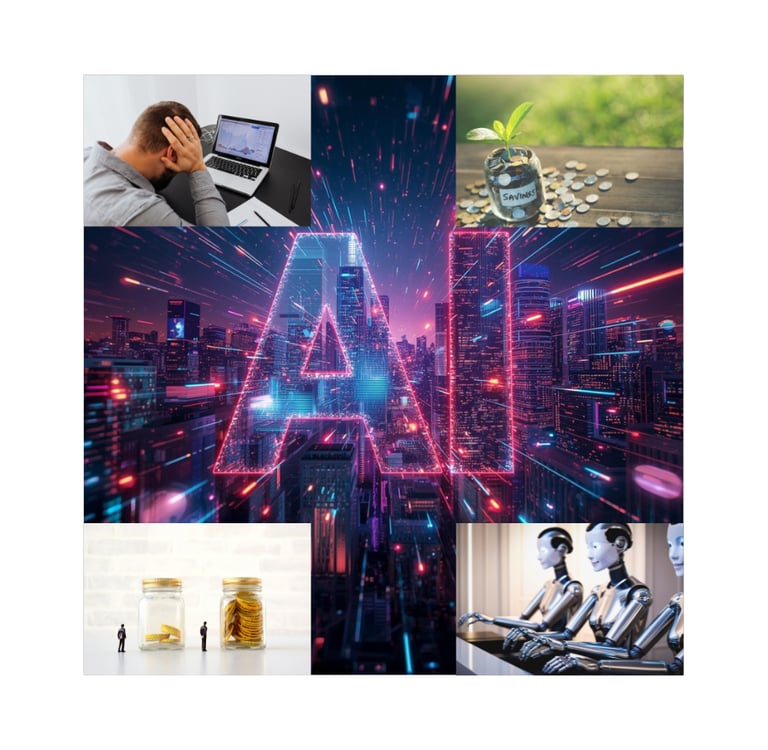
How artificial intelligence is reshaping careers, income stability, and long-term financial planning for professionals
The future of work is no longer a prediction—it is a lived reality.
Artificial intelligence is steadily changing how professionals earn, grow, and plan their financial lives. While much of the public conversation focuses on job loss or technological breakthroughs, the deeper and more lasting impact of AI is financial.
For working professionals—across IT, healthcare, marketing, government, finance, education, creative fields, and service industries—the real challenge is not whether AI will affect their work, but how it will reshape income stability, career longevity, and wealth creation over time.
This pillar explores how AI intersects with careers and money—and why professionals must rethink financial planning in an era where income paths are no longer linear or predictable.
Why AI Is Ultimately a Money Problem
AI does not eliminate work uniformly. It changes how value is created and rewarded.
Some roles see salary pressure, others experience income acceleration, and many face gradual erosion of relevance. These shifts are already visible in technology-driven professions, where AI impact on IT salaries (Coming Soon) is becoming a defining concern for long-term career planning.
Understanding income impact—not just job titles—is the first step toward financial resilience.
Career Security Is Being Rewritten
Traditional career models assumed that experience naturally led to stability. AI disrupts that assumption.
Professionals now face questions like:
Will my role still exist in ten years?
Will my income grow or plateau?
Will my skills remain relevant?
In technology roles, these concerns are shaping decisions around Which IT roles are most future-proof (Coming Soon) and forcing software professionals to confront Automation risk & income planning for Software Professionals (Coming Soon) much earlier in their careers than previous generations.
Preparing for Disruption Before It Happens
Career disruption no longer arrives suddenly—it builds quietly.
AI-driven change often shows up as:
Slower increments
Narrower roles
Fewer advancement paths
Increased performance pressure
Professionals who prepare financially before disruption retain flexibility and control. This mindset shift is central to Preparing financially for career disruption in the age of AI (Coming Soon) and is increasingly relevant across industries.
Skills Alone Are Not Enough—Income Leverage Matters
Learning new skills is important, but income growth depends on how those skills translate into leverage.
Some skills scale across teams, systems, or platforms. Others cap income regardless of expertise. Professionals navigating this reality are increasingly focused on AI skills you need to learn for income leverage (Coming Soon) rather than skill accumulation alone.
This shift also explains why many professionals are exploring Income diversification strategies for IT professionals (Coming Soon) as a form of long-term risk management.
Healthcare: Stability Under Pressure
Healthcare is often viewed as immune to automation—but AI is reshaping it from within.
Doctors, nurses, and caregivers face changing income structures as AI-assisted diagnostics, workflow automation, and platform-based healthcare models expand. These changes directly affect How AI is changing income stability for doctors and healthcare professionals (Coming Soon) and raise new questions about AI impact on private practice vs hospital-employed doctors (Coming Soon).
Clinical roles are also being influenced by Automation and diagnostic AI: career risk for healthcare workers (Coming Soon), making Financial planning for doctors in an AI-driven healthcare system (Coming Soon) a critical consideration.
For nurses and caregivers, adaptability is becoming essential, driving interest in How nurses and caregivers can future-proof income and skills (Coming Soon).
Marketing and Sales: Growth or Compression?
Marketing and sales professionals sit at the intersection of creativity, analytics, and automation.
AI tools are changing how campaigns are created, measured, and scaled—reshaping earning potential in the process. This shift is explored in How AI is reshaping marketing careers and earning potential (Coming Soon) and raises concerns about Sales professionals in the age of AI: income growth or income compression? (Coming Soon).
Variable income structures make Commission-based income planning in AI-driven sales roles (Coming Soon) especially important, while strategic use of tools is redefining advantage through How AI tools change career leverage for marketing professionals (Coming Soon).
Government and Public Sector: Perceived Stability Meets Automation
Public sector careers have long been associated with security and predictability. AI challenges this perception.
Automation in services, digitization of workflows, and data-driven governance are changing job structures, prompting questions like Can AI impact government jobs and public sector income stability? (Coming Soon).
Professionals must now consider Automation in government services: career and pension implications (Coming Soon) and rethink Financial planning for government employees in an AI-enabled system (Coming Soon).
Longevity increasingly depends on Skill relevance and career longevity in public sector roles (Coming Soon) and proactive steps toward How public sector professionals can build financial resilience outside salary (Coming Soon).
Finance, Banking, and Insurance: Reinvention from Within
Few industries are being transformed as deeply as finance.
AI-driven analytics, automation, and compliance tools are altering job roles across banking and insurance. This evolution is central to How AI is transforming banking jobs and financial professionals (Coming Soon) and How AI is redefining insurance industry roles and earnings (Coming Soon).
As traditional career paths shift, Financial planning for finance professionals in an automated industry (Coming Soon) becomes essential to maintain long-term stability.
Education: Teaching in a Hybrid Intelligence Era
Education professionals face a quiet but powerful transformation.
AI-assisted learning, digital platforms, and content automation are influencing How AI is reshaping teaching careers and income opportunities (Coming Soon). At the same time, AI tools and the future earning potential of educators (Coming Soon) is opening new possibilities beyond traditional classrooms.
These changes demand new thinking around Financial planning for teachers in changing education systems (Coming Soon) and How educators can build income beyond traditional teaching roles (Coming Soon).
Creative Professionals: Opportunity Meets Risk
Writers, designers, and video creators are experiencing both disruption and expansion.
AI tools lower production barriers while increasing competition, making AI impact on creative careers: writers, designers, video creators (Coming Soon) a pressing issue.
Sustainable success depends on Building financial stability in creative professions using AI (Coming Soon), Protecting earning power in AI-assisted creative industries (Coming Soon), and intentional Long-term wealth planning for creative professionals (Coming Soon).
Wellness and Service Industries: Human-Centric but Not Immune
Wellness professionals—fitness trainers, salon owners, spa specialists—rely on human connection, but AI still influences pricing, discovery, and demand.
This shift affects How AI and automation affect wellness industry professionals (Coming Soon) and reshapes Income stability for fitness, salon, and spa professionals in the AI era (Coming Soon).
Growth increasingly depends on Using AI tools to grow earnings in the wellness industry (Coming Soon) and robust Financial planning for service-based professionals with variable income (Coming Soon).
The Rise of Hybrid Careers and Multiple Income Streams
As AI shortens relevance cycles, professionals are moving away from single-income dependence.
Managing complexity becomes essential through Managing multiple income streams in AI-driven economies (Coming Soon) and thoughtful Financial planning for professionals with hybrid career paths (Coming Soon).
Ultimately, resilience depends on adaptability, foresight, and structure—captured in How professionals can stay relevant and financially secure long-term even with AI (Coming Soon).
Final Thought
AI is not simply changing how we work—it is redefining how we earn, plan, and protect our financial futures.
Professionals who understand this early can build flexibility, optionality, and long-term security. Those who ignore it may find stability eroding quietly over time.
The future of work may be uncertain—but with the right financial thinking, the future of money does not have to be.
Frequently Asked Questions (FAQs)
1. How will AI affect professional careers and income in the future?
AI is changing how professionals earn, grow, and stay relevant. Some roles will see productivity-driven income growth, while others face automation risk and income pressure. Understanding career leverage, skill relevance, and financial planning together is essential, especially when considering topics like Preparing financially for career disruption in the age of AI (Coming Soon).
2. Will AI reduce salaries or create better-paying opportunities?
AI does both—depending on role and adaptability. Routine tasks may lower wage growth, while AI-augmented roles can command higher pay. This shift is especially visible in technology careers, covered in AI impact on IT salaries (Coming Soon) and Which IT roles are most future-proof (Coming Soon).
3. How should professionals plan finances in an AI-driven economy?
Professionals should focus on income resilience, diversified earning sources, and flexible long-term planning. Traditional single-income dependency is risky in uncertain job markets. This is explored deeper in Managing multiple income streams in AI-driven economies (Coming Soon) and Financial planning for professionals with hybrid career paths (Coming Soon).
4. Is AI a threat to doctors, nurses, and healthcare professionals?
AI is reshaping diagnostics, administration, and patient management, but not replacing human care. Income stability may vary between private practice and institutional roles, which is why planning matters. Related insights are covered in How AI is changing income stability for doctors and healthcare professionals (Coming Soon).
5. Can AI impact government jobs and public sector income stability?
While government jobs are relatively stable, automation is slowly changing role structures, skill requirements, and long-term pension assumptions. Financial resilience beyond salary is becoming important, as explained in Can AI impact government jobs and public sector income stability? (Coming Soon).
6. How is AI reshaping careers in marketing, sales, and creative fields?
AI tools are increasing output but also intensifying competition. Earnings depend on how professionals use AI for leverage rather than replacement. This evolution is explored through How AI is reshaping marketing careers and earning potential (Coming Soon) and AI impact on creative careers: writers, designers, video creators (Coming Soon).
7. What skills should professionals learn to stay financially relevant with AI?
Skills that combine domain expertise with AI tools—strategy, decision-making, creativity, and client trust—retain earning power. Skill relevance directly impacts income growth, which connects closely with AI skills you need to learn for income leverage (Coming Soon).
8. How can professionals stay financially secure long-term despite AI disruption?
Long-term security comes from adaptability, diversified income, and proactive financial planning—not just job stability. Professionals who align career evolution with wealth strategy perform better over decades, as discussed in How professionals can stay relevant and financially secure long-term even with AI (Coming Soon).
Connect
Questions? Reach out anytime, we're here.
lifeworkwealth@gmail.com
© 2026 Life Work Wealth.
All rights reserved.All content published on this website is for informational and educational purposes only. No part of this website may be reproduced, distributed, or transmitted in any form or by any means without prior written permission, except where permitted by law.