Thoughtful perspectives on liVING, career decisions, and wealth building.

Financial Planning for Doctors: From Medical School Loans to Long-Term Wealth
Learn financial planning for doctors from medical school loans to long-term wealth creation. Discover how MBBS and MD doctors can manage education loans, invest salary smartly, plan retirement, and build wealth across government and private practice careers.
FINANCE FOR WORKING PROFESSIONALS
2/18/20265 min read


Doctors invest nearly a decade building their careers before their income stabilizes. By the time earnings begin, many carry education loans, delayed savings, and family responsibilities. Financial planning for doctors must account for delayed income, high stress, uneven earning curves, and strong long-term potential.
This guide walks through the financial journey of doctors—from MBBS to senior consultant—covering loans, government vs private practice income, and a clear, age-wise investment strategy.
1) Medical Student Phase (Age 18–24): Awareness Before Income
Costs are high, income is zero. Focus on:
Choosing structured education loans over informal borrowing
Avoiding lifestyle debt
Learning basics of budgeting, insurance, and investing
Building a clean credit history
Goal: financial literacy and damage control—not investing yet.
2) Early Career (Age 25–30): Internship & Junior Residency
Income begins but remains modest. This phase sets habits.
Monthly Income Allocation (guideline):
Living costs: 55–60%
Education loan repayment: 25–30%
Investments: 10–15%
Investment Split (of the 10–15% invested):
SIPs (equity mutual funds/index funds): 60%
FDs / liquid funds (emergency buffer): 25%
Precious metals (gold ETF/SGB): 10%
Direct stocks (optional, learning allocation): 5%
Focus:
Build 6 months’ emergency fund
Start small SIPs for habit formation
Health + term insurance
3) Degree Path Impact: MBBS vs MD/MS
MBBS-only doctors typically see steadier but slower income growth.
MD/MS or super-specialists face higher loans but higher earning ceilings.
MBBS Track (Age 28–35) – Monthly Allocation:
Living costs: 50–55%
Loan repayment (if any): 20–25%
Investments: 20–25%
MD/MS Track (Age 28–35) – Monthly Allocation:
Living costs: 45–50%
Loan repayment: 25–30%
Investments: 20–25%
Investment Split (of invested portion):
SIPs (equity funds): 65–70%
FDs/liquid funds: 10–15%
Precious metals: 5–10%
Direct stocks: 5–10%
International equity (optional): 0–5%
Focus: aggressive loan reduction alongside disciplined investing.
4) Workplace Reality: Government vs Private Hospitals
Government Hospitals
Pros: stability, predictable increments, retirement benefits
Cons: slower salary growth
Private Hospitals/Nursing HomesPros: faster income growth, incentives
Cons: variability, contract risk
Allocation Difference:
Government doctors can run consistent SIPs and long-term plans with lower buffers.
Private doctors should keep a 12-month emergency fund and avoid lifestyle inflation.
5) Prime Growth Phase (Age 30–40): The Compounding Decade
Income rises significantly. This is the most powerful decade for wealth building.
Monthly Income Allocation:
Living costs: 40–45%
Loan repayment (if any): 10–15%
Investments: 40–45%
Investment Split (of invested portion):
SIPs (equity mutual funds/index + flexi-cap): 55–60%
Direct stocks (selective, long-term): 10–15%
International equity funds: 5–10%
FDs/liquid funds: 10%
Precious metals: 5–10%
REITs/InvITs (real estate exposure without ownership): 0–5%
Optional Entrepreneurial Track (if clinic/nursing home is a goal):
Allocate 5–10% of income to a business fund (separate account)
Build capital for equipment, compliance, and working capital
Avoid using core retirement investments for business risk
6) Peak Earnings (Age 40–50): Scale, Then Stabilize
This phase brings peak income and higher responsibilities.
Monthly Income Allocation:
Living costs: 35–40%
Investments: 45–50%
Business/Real estate (optional): 10–15%
Investment Split (of invested portion):
Equity SIPs: 45–50%
Debt funds/FDs: 20–25%
Direct stocks: 10%
Precious metals: 5–10%
Real estate/REITs: 5–10%
Clinic/Nursing Home Ownership (if pursued):
Cap exposure to ≤25–30% of total net worth
Maintain separate personal emergency and retirement portfolios
Insure professional and business risks
Focus: build passive income, rebalance annually, protect capital.
7) Consolidation (Age 50+): Protect, Generate Income
Monthly Income Allocation:
Living costs: 45–50%
Investments/savings: 25–30%
Passive income assets: 20–25%
Portfolio Tilt:
Equity: 30–40%
Debt (FDs, high-quality bonds): 40–50%
Precious metals: 5–10%
Real estate/REITs: 5–10%
Focus: income stability, healthcare planning, estate planning, will.
8) Education Loan Strategy for Doctors
Prioritize higher-interest loans first
Use bonuses/incentives to reduce principal
Begin parallel investing once EMI is comfortable
Avoid extending loan tenure just to fund lifestyle upgrades
9) Insurance & Risk Management (Often Ignored)
Term life insurance (10–15× annual expenses)
Comprehensive health insurance beyond employer cover
Professional indemnity insurance
Disability insurance (if available)
10) Common Mistakes to Avoid
Delaying investing until late 30s
Lifestyle inflation after specialization
Overconcentration in clinic real estate
Trading frequently due to lack of time
Ignoring retirement corpus planning
11) Simple Rules Doctors Can Follow
Automate SIPs right after salary credit
Review annually; don’t micromanage markets
Increase investments with income hikes, not expenses
Keep business capital separate from retirement money
Rebalance asset allocation every 2–3 years
FAQs
1) When should doctors start investing if they have large education loans?
Start small alongside EMI once income stabilizes. Clear high-interest debt aggressively, but don’t delay habit formation.
2) How much should a young doctor invest monthly?
Aim for 10–15% early, rising to 30–45% as income grows in your 30s.
3) Are direct stocks necessary?
Not necessary. SIPs in diversified equity funds are sufficient for most doctors with limited time.
4) Should doctors buy real estate or open a clinic?
Only if financially prepared. Cap business exposure and protect retirement funds from business risk.
5) How often should portfolios be reviewed?
Once a year is enough. Avoid reacting to short-term market noise.
Final Thoughts
Doctors sacrifice early years to build a career of service. Financial planning ensures that sacrifice converts into long-term security. The winning formula is simple: disciplined saving, diversified investing, controlled lifestyle growth, and risk protection. Start early, scale smartly in your 30s and 40s, and protect capital as you approach consolidation years.
If you’d like, I can provide a printable age-wise allocation table, a retirement corpus calculator, or a one-page checklist for doctors to implement this plan.
Bonus Publications
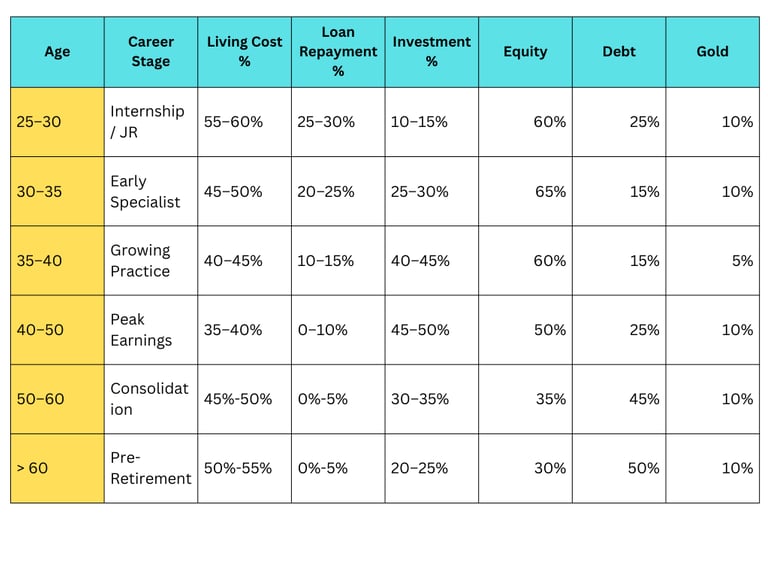
✅ Age-Wise Allocation Table for Doctors
Notes:
Equity = SIPs, index funds, diversified funds, selective stocks
Debt = FD, bonds, debt funds
Real estate/clinic allocation must not exceed 30% of total net worth
Increase investment % with every salary increment
✅ Retirement Corpus Calculator for Doctors
Now let’s calculate how much a doctor actually needs.
Step 1: Estimate Annual Expenses at Retirement
Example:
Current monthly expense: ₹1,00,000
Annual expense: ₹12,00,000
Assume inflation: 6%
Years to retirement: 25
Future Expense Formula:
Future Expense = Current Expense × (1 + Inflation)^Years
Example:
₹12,00,000 × (1.06)^25
= ₹12,00,000 × 4.29
= ₹51,48,000 per year
So at retirement, doctor needs ~₹51 lakh per year.
Step 2: Retirement Corpus Needed
Safe withdrawal rate assumption: 3.5%–4%
Corpus Needed Formula:
Corpus = Annual Expense ÷ Withdrawal Rate
Using 4% rule:
₹51,48,000 ÷ 0.04
= ₹12.87 Crores
So retirement corpus required ≈ ₹13 Crores
✅ Simplified Retirement Corpus Shortcut Rule
You can also use:
Required Corpus = 25 × Annual Expenses at Retirement
If retirement expense = ₹50 lakh
Corpus needed = ₹12.5 Crores
✅ How Much Should Doctors Invest Monthly to Reach ₹13 Crores?
Let’s assume:
Current Age: 35
Retirement Age: 60
Years to invest: 25
Expected return: 11% (equity heavy portfolio)
Using SIP calculation approximation:
To reach ₹13 Crores in 25 years at 11% return:
Monthly SIP required ≈ ₹1.2 – ₹1.4 lakh
If doctor starts at age 40 instead of 35:
Required SIP jumps to ≈ ₹2.3 – ₹2.6 lakh
This shows one critical truth:
Delay by 5 years = double the effort required.
✅ Practical Retirement Strategy for Doctors
Age 25–35:
Build habit, not corpus
Focus on loan clearance + early SIP
Age 35–45:
Aggressively increase SIP by 10–15% every year
Direct bonuses into investment
Age 45–55:
Shift gradually from 70% equity → 50% equity
Protect corpus
Age 55+:
Focus on income generating assets
Create laddered FD + bond structure
✅ Key Financial Planning Truth for Doctors
Because income starts late, doctors must:
Increase savings rate faster than peers
Avoid luxury lifestyle upgrades too early
Invest aggressively in 30s and 40s
Protect against professional burnout
Separate clinic investment from retirement fund
Connect
Questions? Reach out anytime, we're here.
lifeworkwealth@gmail.com
© 2026 Life Work Wealth.
All rights reserved.All content published on this website is for informational and educational purposes only. No part of this website may be reproduced, distributed, or transmitted in any form or by any means without prior written permission, except where permitted by law.